
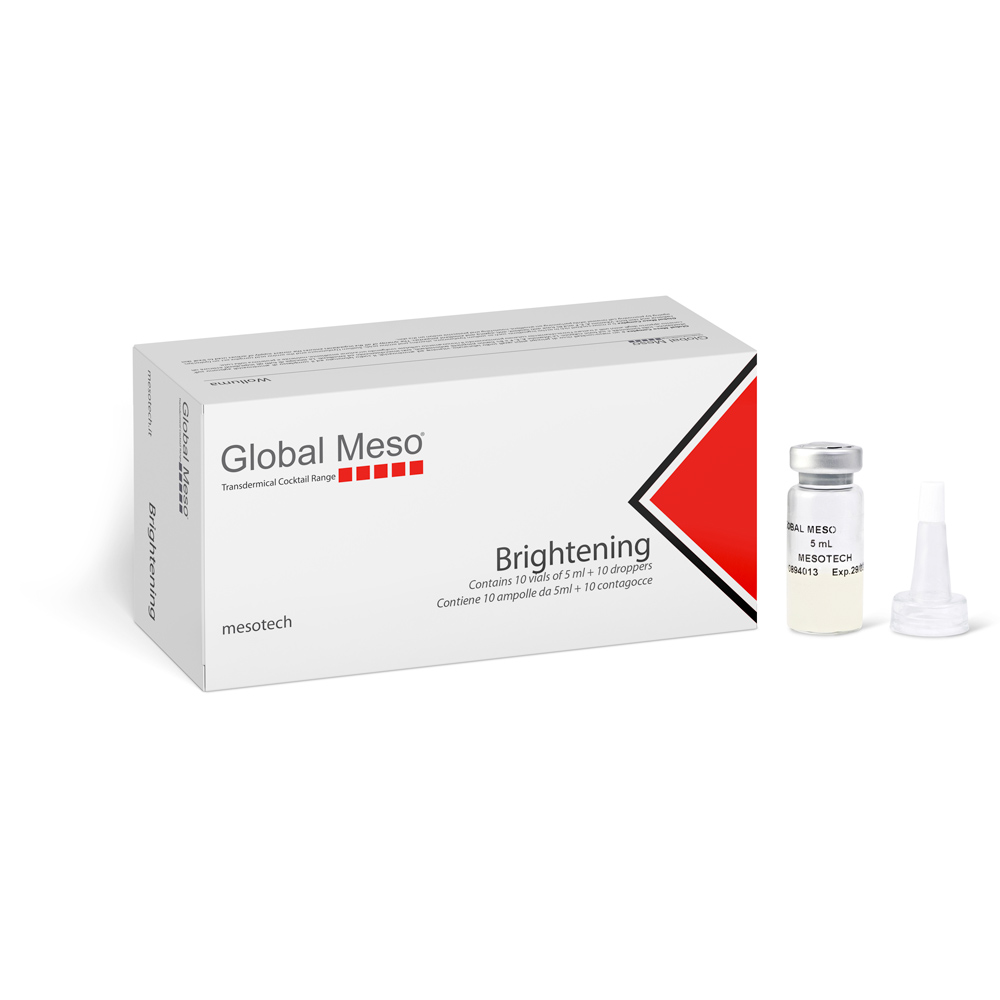
Global Meso Brightening
Mesococktail ready to use to reduce hyperpigmentations
| Indications | Hyperpigmentations |
| Actives | Arbutin, Kojic acid, Pueraria, Vit. A, Tranexamic Acid |
| Results | Reduce the hyperpigmentations |
| 1 box contain |
|
Global Meso Brightening is a targeted mesotherapy formulation designed to restore brightness and uniformity to the skin.
Its carefully selected active ingredients work synergistically to reduce the appearance of uneven skin tone and discoloration, while supporting the skin’s natural defense mechanisms against oxidative damage.
The formula helps revive dull and stressed skin, improving clarity and luminosity without altering the skin’s natural balance.
Ideal for photo-exposed, tired or uneven skin, it leaves the complexion visibly brighter, more uniform and radiant, with a healthier and revitalized look.
Arbutin: A natural glucoside of Hydroquinone, chemically known as Hydroquinone-β-D-Glucopiranoside, the mechanism of action, however, seems different, as studies on cultures of human melanocytes have suggested that it does not act on synthesis or on expression of the enzyme. Clinical studies have verified that its applications do not give the appearance of side effects, unlike the Hydroquinones.
Kojic Acid: inhibits the enzyme tyrosinase, chelating copper in the active site. Clinical studies have shown that the Kojic acid and its esters have depigmenting properties and are considered safe and non-toxic. The inhibitory effect on melanin formation is due both to the inhibiting activity of the transcription factor associated with microphthalmia (MITF), and to the inhibition of the activity of the alpha-melanocyte stimulating hormone (alpha-MSH).
Vitamin A: Retinoic Acid also acts as a depigmenting agent and can produce a lightening effect when applied topically. The mechanism of action, although not fully clarified, is connected on one hand to the increased cell turnover of keratinocytes, thus facilitating the loss of pigment from the epidermis, on the other to an indirect strengthening of the cytotoxic effect on melanocytes of some skin depigmentants, through the inhibition of detoxification pathways (with relative increase of toxic species such as quinones).
Pueraria (Kudzu): The root and the flower, used in traditional medicine, have various medicinal properties. Numerous studies have shown the activity of extracts of this plant towards melanogenesis. The activity of suppression of melanogenesis has been confirmed visually by the coloration of Fontana-Masson.
Tranexamic acid: is a synthetic molecule derived from lysine, used primarily as an antihemorrhagic drug to prevent and treat excessive bleeding (by blocking the dissolution of blood clots) and in cosmetics for its lightening and anti-blemish properties, reducing hyperpigmentation and skin inflammation by acting on excess melanin.
Dermapen Meso Cocktail Range
Global Meso Brightening
Mesococktail ready to use to reduce hyperpigmentations


Global Meso Wolluma
Bio-authentic exosomes: the future of skin regeneration in your daily routine